
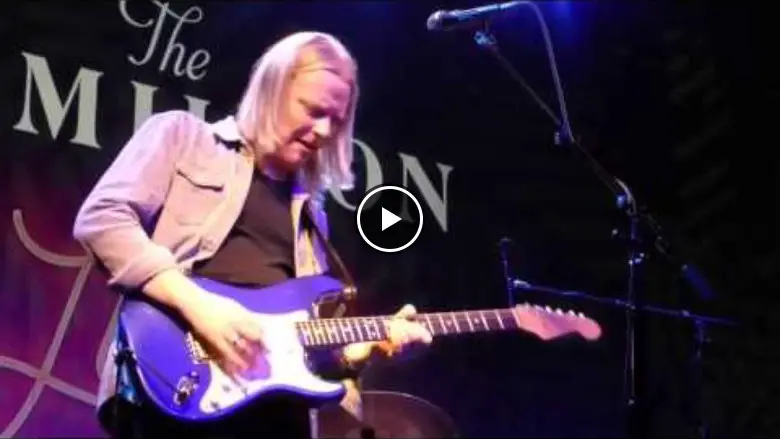
The Architect of the Blue Note: The Transatlantic Soul of Matt Schofield
The air in the room usually changes before Matt Schofield even strikes a chord. It’s a tension born of expectation—the kind of quiet that settles over a crowd when they know they’re about to witness a masterclass in the “un-teachable.”
Born in Manchester and forged in the smoky, high-stakes venues of London and the U.S., Schofield doesn’t just play the blues; he deconstructs them. He puts them back together with the precision of a Swiss watchmaker and the raw heart of a Delta shouter, solidifying his reputation as a premier English blues guitarist.
The Spark in the Static: A Musical Evolution
Every legend has a “Big Bang” moment. For Schofield, it was a grainy VHS tape. At twelve years old, while visiting his father in Northern California, he watched a video of B.B. King, Albert Collins, and Stevie Ray Vaughan jamming together. It wasn’t just music; it was a revelation.
While most kids were chasing the neon-drenched pop of the late 80s, Schofield was diving headfirst into his father’s vinyl collection. He traced the lineage from Muddy Waters to Billy Gibbons, obsessed with the alchemy of wood, wire, and electricity. This deep immersion into the blues tradition allowed him to develop a voice that is uniquely his own.
“Improvisation is about taking what you hear in your head… and translating it to your fingers. It’s not about play-by-the-numbers.” — Matt Schofield
The Sound of Three: Redefining the Blues Trio
When Schofield formed the Matt Schofield Trio, he made a radical choice that would become his sonic signature: he ditched the bass player. By replacing the traditional four-string with the swirling, foundational low-end of Jonny Henderson’s Hammond organ, Schofield created a space that was simultaneously airy and immense.
This unconventional lineup forced him to rethink the guitar’s role. He couldn’t just lean on a rhythm section; he had to be the rhythm, the melody, and the soul all at once. The result is a fluid, jazz-inflected blues fusion that feels like a sophisticated conversation between old friends in a late-night bar.
Anatomy of a Tone: Gear and Technique
To talk about Matt Schofield is to talk about Tone with a capital T. He is a devotee of the “less is more” philosophy, yet his sound is anything but thin.
- The Instrument: His 1961 Stratocaster is the stuff of gearhead dreams—battered, bruised, and imbued with a resonance that feels like it has a pulse.
- The Engine: His collaboration with Two-Rock Amplifiers led to the creation of the Schofield Signature, an amp designed to capture the “bloom” of a note.
- The Secret Sauce: It’s in the fingers. Schofield’s vibrato is a living thing—wide, controlled, and deeply emotive. He plays “the changes” like a jazz veteran but hits the blue notes with the weight of a man who has seen it all.
Legacy and the “Many Moons”
With three “British Blues Guitarist of the Year” awards and an induction into the British Blues Hall of Fame, Schofield’s place in the musical pantheon is secure. He stands alongside Eric Clapton and Peter Green as a defining voice of British blues, but he refuses to be a museum piece.
His recent work, including the Many Moons project, sees him reuniting with his original trio, proving that the blues isn’t a destination—it’s a journey that keeps circling back to the truth. Whether he’s teaching through his Blues Speak series or headlining international festivals, Schofield remains the same kid from Manchester: eyes closed, head tilted, chasing that one perfect, heartbreaking note.
Video
Thank You
We appreciate your time and dedication to reading our article. For more of the finest blues guitar music, make sure to follow our Facebook page, “I Love Blues Guitar”. We share exceptional selections every day. Thank you once again for your continued support and readership.

Facebook Comments